
 EN
EN




High Precision CNC & EDM Machining: The Core Support of Custom Injection Mold Manufacturing
The precision of an injection mold directly governs two non-negotiable quality indicators for any plastic product: dimensional accuracy and surface finish. Behind both lies one critical foundation — the caliber of CNC machining and EDM electrical discharge machining equipment deployed in the toolroom. In recent years, we have systematically upgraded our mold processing workshop, introducing a full suite of high-speed CNC machining centers paired with precision EDM forming machines. This dual-technology investment has significantly strengthened our capability to machine complex cavity geometries and microscopic gate structures that define high-performance molds. For buyers sourcing custom injection molds, a supplier's machining backbone is not a secondary detail — it is the most reliable predictor of whether a delivered mold will perform consistently across tens of thousands of injection cycles. This article examines how these two core processing technologies work in complementary sequence to elevate mold quality while compressing the overall mold development cycle.
CNC machining centers serve as the primary workhorses for rough machining and semi-finishing of mold bases and mold cavities. In contrast to traditional manual milling machines — where output quality depends heavily on operator skill and fatigue — digital CNC equipment executes fully automated program-driven machining, maintaining positioning tolerance within ±0.01 mm across every operation. For the daily mold making tasks in our workshop — mold base drilling, cavity roughing, and gate pre-machining — CNC equipment delivers batch processing with repeatable precision, effectively eliminating the dimensional variance introduced by manual operation. A practical illustration is the micro-hole drilling required for submarine gate systems: our CNC machine tools can drill dense arrays of tiny positioning holes and gate runner channels into a mold cavity in a single setup, producing uniformly smooth hole walls that establish an optimal foundation for the downstream EDM finishing stage. Before high-precision CNC equipment became standard in our workshop, a technician would spend two to three days manually marking, centering, and drilling a single complex mold cavity. That same work now completes within eight hours through automated CAM programming — the 3D mold model is imported directly into the CAM software, toolpaths are generated algorithmically, and the CNC machine executes the entire sequence unattended. This reduction directly compresses the mold opening timeline and enables us to deliver first-off trial molds to customers substantially faster.
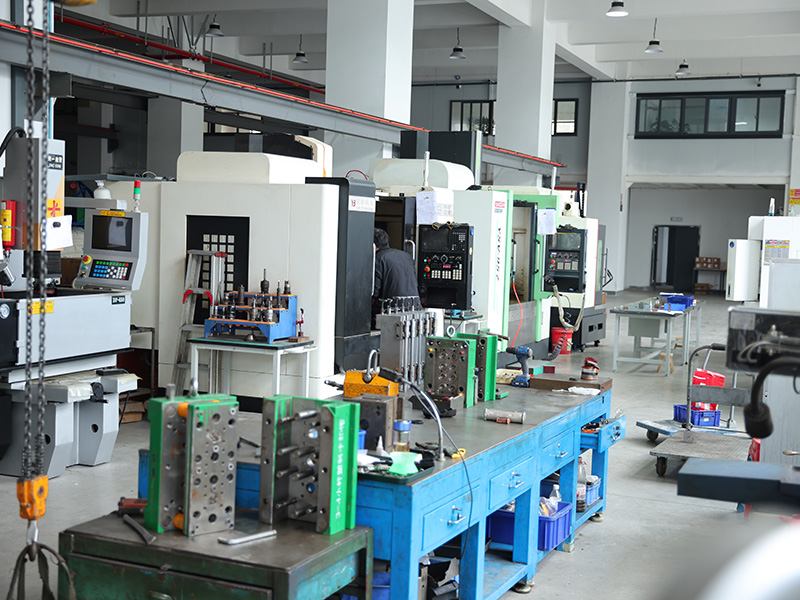
Where CNC rough machining leaves off, EDM electrical discharge machining takes over for ultra-fine finishing of complex cavities and concealed gate positions. The operating principle of EDM is fundamentally different from mechanical cutting: it employs pulsed electrical discharge to erode tool steel through controlled spark erosion, enabling it to machine narrow, deep, and irregular geometries that physical cutting tools simply cannot reach — such as microscopic hidden submarine gate tunnels, deep thin-wall ribs, and intricate textured cavity surfaces. In our workshop, every EDM machine is equipped with an independent cooling circulation system that maintains stable processing temperature throughout the discharge cycle, which is essential for achieving consistent surface roughness across the entire mold cavity. For plastic products that require a mirror-surface finish on the molded part, we execute multi-stage EDM fine-discharge processing followed by manual polishing, progressively reducing discharge energy through each stage to produce a burr-free, high-gloss mold inner wall that transfers directly to the plastic surface. This capability is especially valued by buyers of cosmetic housings, transparent components, and consumer-facing plastic parts where surface quality is a direct proxy for perceived product value.
The coordinated interplay between CNC and EDM technologies also translates into measurably lower mold failure rates during subsequent mass production. When mold cavity dimensions are uneven or gate runners retain residual burrs, the plastic melt flows non-uniformly during injection, manifesting as product deformation, sink marks, shrinkage, and flash in the finished parts. The dual-process machining approach — CNC for macro geometry and EDM for micro finishing — brings all dimensional errors within the customer's specified tolerance band. As a result, our first-article mold trial yield rate has improved by more than 30 percent compared with the earlier single-process machining mode. Multiple overseas customers specializing in precision electronic plastic components have independently confirmed our processing capability after workshop visits, recognizing that tight control over microscopic gate and cavity details is the decisive factor for stable high-volume production of small electronic accessories.
Beyond the equipment itself, our workshop is staffed with professional mold technicians proficient in both CNC programming and EDM operation — a cross-disciplinary skill set that ensures seamless workflow continuity between the two processing stages. After machining, every mold passes through a three-stage inspection protocol: dimensional verification using calibrated calipers and coordinate measuring instruments, surface roughness measurement against specification targets, and mold flow simulation testing to validate fill behavior before the mold ever reaches the injection machine. Any semi-finished component that falls outside tolerance is immediately returned to the processing workshop for rework, creating a hard gate that prevents defective mold elements from reaching the assembly stage.
For global purchasers evaluating injection mold suppliers, the depth and integration of a factory's machining equipment serve as one of the most reliable proxies for manufacturing capability. Our complete CNC and EDM production lines are configured to support the full spectrum of custom mold requirements — from micro-precision electronic component molds with hair-thin gate features, to large-format household plastic part molds demanding consistent cavity uniformity. Every mold set we deliver carries the assurance of a precision infrastructure built on the strategic pairing of high-speed CNC and multi-stage EDM technology — a combination that turns tooling investment into long-term production reliability.