
 EN
EN



Full-Automatic Injection Molding Workshop: Realizing Stable Mass Delivery for Plastic Product Orders
For cross-border plastic product purchasers, stable mass production delivery capacity carries equal weight with mold precision — yet it is often overlooked during supplier evaluation. Many small mold factories possess mold opening capabilities but lack standardized injection molding production lines. This structural gap exposes buyers to three critical risks after mold customization is complete: delayed delivery schedules, inconsistent product quality across batches, and inventory shortages that disrupt downstream supply chains. Our facility addresses this challenge head-on with a full-automatic injection molding workshop spanning over 2,000 square meters, housing dozens of servo-driven injection molding machines paired with dedicated robotic manipulators. The result is a genuine one-stop service chain — from mold design and development through to high-volume plastic part production — eliminating the coordination gaps that plague multi-vendor sourcing models.
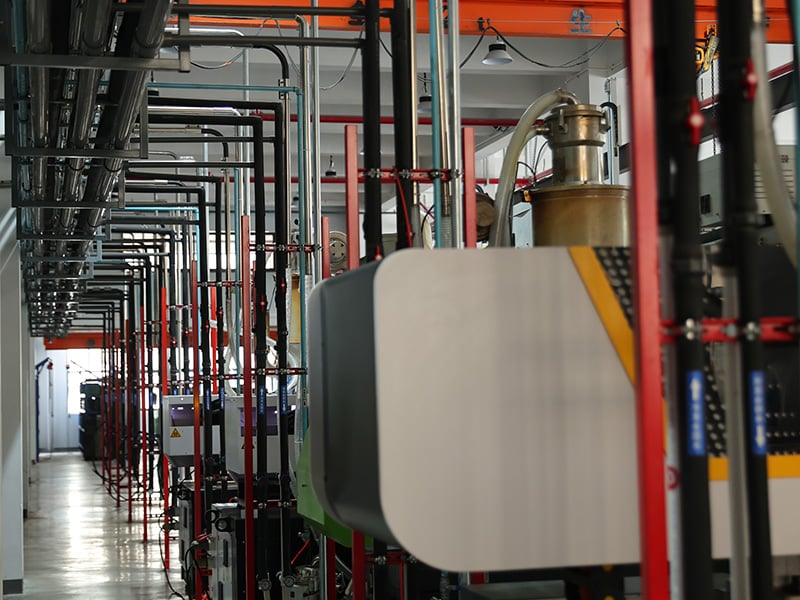
The defining advantage of our fully automated injection workshop lies in the intelligent pairing of injection machines with robotic manipulators. Each green servo injection molding machine is integrated with a dedicated robotic arm programmed to extract finished plastic parts immediately after mold opening, removing the need for manual part removal entirely. Compared against traditional manually-operated production lines, this automated extraction system delivers two measurable benefits: it prevents surface scratches and contamination caused by human handling, and it raises per-machine daily output by nearly 40 percent. For products engineered with submarine gate designs, the robotic manipulator works in synchronization with an automatic gate-breaking structure to sever finished parts from runner material in a single cycle. This integration cuts post-processing workload on the assembly line by more than half, accelerating throughput while reducing labor dependency. All injection equipment is networked into a unified central control system, allowing operators to adjust production parameters — injection pressure, mold temperature, and cooling time — uniformly across the entire machine fleet. This centralized parameter control ensures dimensional consistency and surface appearance uniformity for every plastic part in every production batch.
The workshop follows a standardized zonal management layout, partitioned into four functional areas: raw material storage, injection production zone, finished product assembly line, and finished goods warehouse. The raw material warehouse stocks a broad range of engineering and commodity plastics — including PP, ABS, PC, and PA6 — each stored with independent moisture-proof enclosures and dedicated drying equipment. This environmental control is essential because residual moisture in raw resin is a leading cause of surface defects such as bubbles, silver streaks, and water lines on molded parts. Before commencing any production batch, our quality inspection team conducts melt flow index sampling tests on the designated raw material to verify that the resin lot meets the customer's specified formulation and performance requirements. Only after material certification is the batch cleared for production. The injection production area is built to full compliance standards with comprehensive fire protection systems, enclosed pipeline circulation networks, and clearly marked safety zoning lines that separate equipment pathways from personnel walkways. This operational discipline has been validated through multiple successful factory audits conducted by overseas customers.
Once plastic parts are extracted by the robotic manipulators, they are transferred via conveyor belt directly to the assembly and quality inspection line. The assembly workshop operates under standardized work instructions, with all operators following strict production management procedures designed to prevent dust and particulate contamination on product surfaces — a detail that matters greatly for industries with high cosmetic or functional cleanliness requirements. The inspection protocol follows a three-gate process: visual appearance inspection to catch surface-level defects, dimensional sampling measurement using calibrated instruments to verify tolerance compliance, and functional assembly testing to confirm part fit and performance. Defective units exhibiting flash, sink marks, shrinkage, or excessive gate vestige are identified and segregated in real time. Qualified finished products proceed to classification, packaging, and transfer to the finished goods warehouse. This end-to-end closed-loop quality control system sustains a defect rate consistently below 0.8 percent, providing buyers with the batch-to-batch reliability that long-term procurement programs demand.
Regarding production throughput, our injection workshop can run simultaneous mass production across more than 50 active mold sets, delivering daily output capacity in the hundreds of thousands of plastic parts. For customers facing urgent bulk order deadlines, we have the scheduling flexibility to re-prioritize equipment allocation and compress lead times without compromising quality controls. The operational depth of having both mold fabrication and injection production under one roof is what drives sustained preference among our long-term overseas partners. These buyers avoid the inefficiency of sourcing a separate injection factory after completing mold development — eliminating the communication overhead, quality handover friction, and schedule misalignment that inevitably arise when splitting these interdependent processes between two suppliers.
Beyond the injection workshop itself, our complete industrial infrastructure extends to a dedicated mold processing workshop, an EDM precision machining workshop, and a 720-degree VR factory tour system that gives customers remote visibility into every production stage of their orders — no physical travel required. Whether a buyer's requirement is limited to custom mold tooling alone, or encompasses simultaneous mold development with ongoing mass injection production, our vertically integrated production chain delivers matched, scalable solutions. This full-spectrum capability is designed to support the long-term, stable order volumes that define successful partnerships between global plastic product buyers and their manufacturing base.